Somewhere in your organization, there’s a Copilot license nobody uses. A ChatGPT Enterprise seat that gets opened twice a week. A pilot that ran for 90 days, produced a slide deck, and quietly stopped.
You’re not alone. 95% of enterprise AI pilots deliver zero measurable P&L impact, according to an MIT study. Despite 86% of C-suites raising their AI budgets, only 32% report sustained impact from their investments. And 79% of organizations say they face challenges adopting AI, a double-digit increase from last year.
The money is moving. The results aren’t.
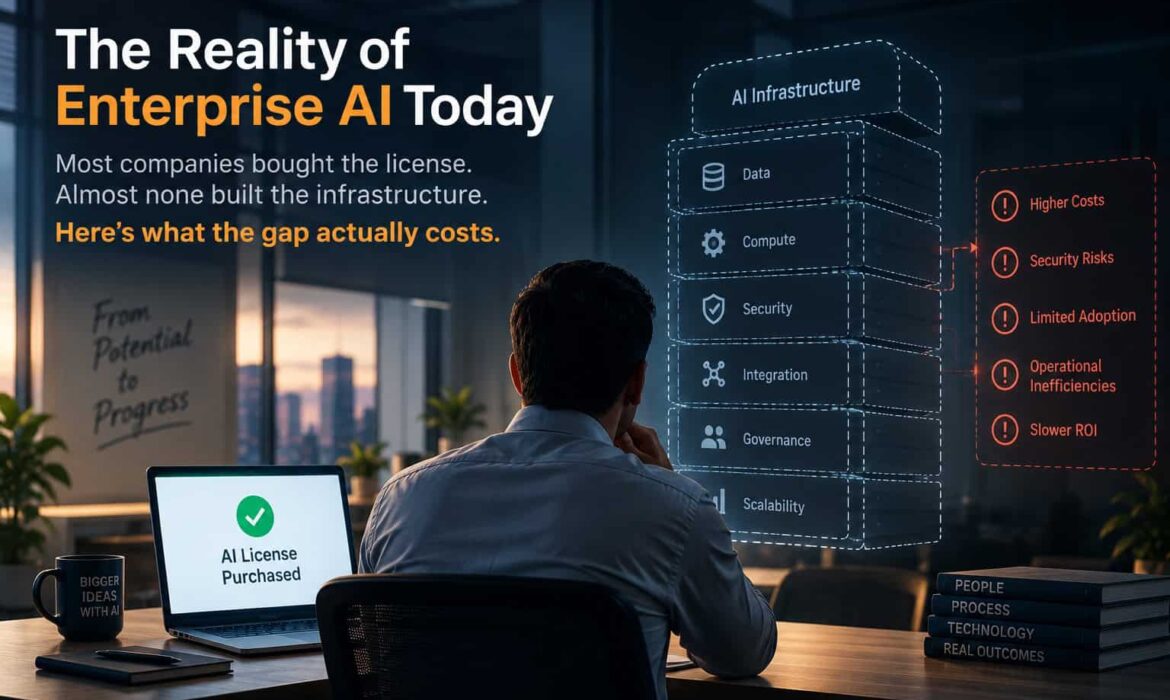
This isn’t a technology problem. It’s an infrastructure problem. And until enterprises understand the difference, they’ll keep buying licenses and calling it transformation.
What “Buying AI” Actually Gets You
When a company purchases Microsoft 365 Copilot, ChatGPT Enterprise, or any major AI platform, they get access to a capable model sitting on top of a generic knowledge base. The model is impressive in demos. It writes well, summarizes fast, and answers broad questions confidently.
What it doesn’t get you: AI that knows your business, integrates into your workflows, connects to your actual data, or gives your teams a reason to open it tomorrow.
Fewer than 4 in 10 employees with Copilot access actively use it. When employees have both Copilot and ChatGPT available, 76% choose ChatGPT. Not because Copilot is a bad product, but because without deliberate implementation, neither tool is meaningfully better than what people were already doing.
The license is the starting line, not the finish line. Most enterprises treat it as both.
The Three Gaps Nobody Budgets For
Enterprise AI implementations fail in predictable places. The technology rarely lets you down. The infrastructure around it almost always does.
The data gap. AI is only as useful as the information it can access. Most enterprises have their knowledge scattered across SharePoint folders nobody has organized in three years, email threads, PDFs no one can find, and systems that don’t talk to each other. Dropping a model on top of that chaos produces chaotic results. Cleaning and structuring that knowledge base is unglamorous work, but it’s the work that determines whether the AI is useful or not.
The workflow gap. An AI tool that lives next to your existing workflows is a convenience, not a transformation. The difference between enterprises seeing real ROI and those stuck in pilot purgatory is almost always integration depth. When AI is embedded in the process rather than offered alongside it, usage becomes automatic rather than intentional. That shift doesn’t happen by default.
The adoption gap. The single most common failure point in enterprise AI rollouts is skipping structured training and assuming employees will figure it out. They don’t. Not because they lack capability, but because nobody showed them how the tool makes their specific job easier. Adoption is a design problem, not a motivation problem.
What the Gap Actually Costs
The visible cost is easy to calculate: software licenses paid for tools nobody uses. The average enterprise is now postponing 25% of planned AI spend because CFOs are demanding ROI evidence that can’t be produced.
The invisible cost is harder to see but larger. Every week your AI isn’t working, competitors who built the infrastructure are compounding their advantage. They’re onboarding new employees faster. Their teams are answering customer questions with greater consistency. Their institutional knowledge is accessible and queryable. Yours is still locked in someone’s inbox.
The gap between enterprises that bought AI and enterprises that built AI infrastructure isn’t closing on its own. It’s widening.
What Building the Infrastructure Actually Means
Infrastructure doesn’t mean servers and DevOps. For most enterprises it means three things.
First, a knowledge layer: your documents, policies, processes, and institutional knowledge organized, cleaned, and connected to the AI in a way that produces reliable answers.
Second, workflow integration: AI embedded into the tools your teams already use, not added as a separate tab they have to remember to open.
Third, deployment with governance: the right people accessing the right information, with audit trails, role-based permissions, and a setup your IT and compliance teams can stand behind.
None of this requires a team of ML engineers. It requires a clear implementation approach, the right tooling, and someone who has done it before.
Why Most Enterprises Haven’t Done This Yet
The honest answer is that the vendor ecosystem isn’t incentivized to tell you what’s missing. Selling licenses is simpler than selling transformation. Demo environments are clean. Real enterprise environments are not.
The gap between what AI looks like in a vendor demo and what it takes to make it work inside your actual organization is where most implementations quietly die. It’s not dramatic. There’s no moment of failure. The pilot just loses momentum, the champion moves on to something else, and the licenses keep renewing because cancelling them feels like admitting defeat.
Building real AI infrastructure requires someone to own it, with the expertise to make it work and the honesty to tell you what it will actually take.
What CloudTern Does Differently
We don’t sell licenses. We build the infrastructure that makes them worth buying.
That means auditing your knowledge layer before touching a model, designing workflow integrations that make adoption automatic rather than effortful, and deploying tooling like AnythingLLM that gives your teams a client they’ll actually use across desktop, mobile, and web, connected to your actual data, running on infrastructure you control.
We’ve seen what the gap looks like from the inside. We know how to close it.
CloudTern helps mid-market and enterprise companies move from AI spend to AI infrastructure. If your organization has invested in AI and isn’t seeing the results, let’s talk about why and what to do about it.