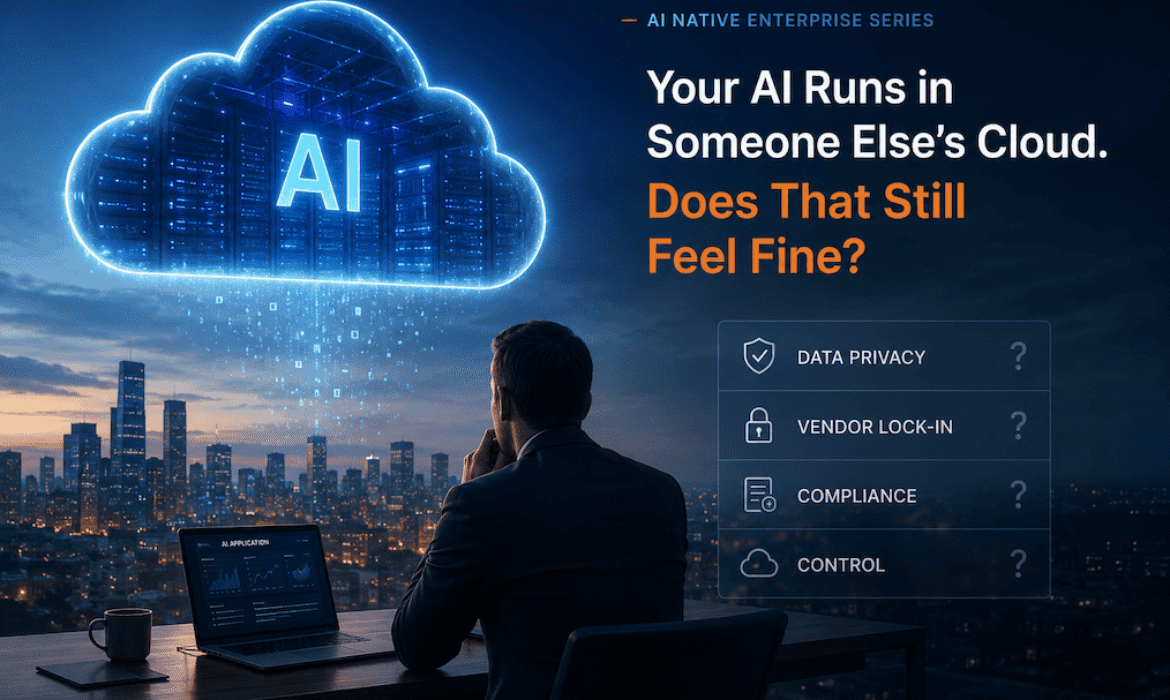
Your most sensitive business data, customer conversations, and proprietary workflows are being processed on a server you don’t own, under terms that can change with a policy update you probably won’t notice.
For many teams, that’s been an acceptable trade-off. The models were impressive, the setup was fast, and the results looked good in demos. But 2026 is a different conversation.
The EU AI Act is now in full enforcement. HIPAA, GDPR, and SOC 2 audits are asking harder questions. CISOs and legal teams are looking at their AI stack and asking something they should have asked earlier: where does our data actually go?
This is the question that brings enterprises to self-hosted AI. And it’s the question that CloudTern was built to answer.
What “AI Native” Actually Means (and What It Doesn’t)
There’s a lot of noise around “AI Native Enterprise.” Most of it means: we added AI to some processes and called it a transformation.
A genuinely AI Native Enterprise is one where AI is the operating layer underneath workflows, not a tool bolted on top. Decisions happen faster because AI is embedded in the process. Institutional knowledge lives in systems the whole organization can query. Workflows that used to require three people and a spreadsheet now run autonomously.
That kind of transformation doesn’t happen by giving everyone a ChatGPT subscription. It requires the right models, running in the right place, connected to your actual data, with access controls your teams will actually use.
Why Self-Hosted Models Are No Longer Optional for Serious Enterprises
Three years ago, self-hosting an LLM meant GPU clusters, ML engineers, and months of infrastructure work. That changed.
Open-weight models like LLaMA, Mistral, Qwen, and DeepSeek now deliver performance competitive with frontier commercial models. Running them on private infrastructure via Ollama has become straightforward. And the compliance math has shifted decisively. Organizations that moved to self-hosted AI in 2025 saw a 75% reduction in data breach exposure. For healthcare, insurance, legal, and financial services, self-hosting isn’t a preference. It’s the only architecture that clears the compliance bar.
What you get when AI runs on your infrastructure:
Data stays yours. No vendor’s privacy policy governs what happens to your prompt about a patient, a deal, or pending litigation.
You control the model. Run a validated, frozen version. Switch providers without migrating APIs. The model is yours.
Logs are auditable. Regulators can trace every AI-assisted decision through infrastructure you manage, not through a cloud vendor’s support ticket.
Costs drop at scale. Per-token cloud API fees disappear entirely.
AnythingLLM: The Client Your Enterprise Has Been Waiting For
The hardest part of enterprise AI isn’t the model. It’s the last mile: getting AI into the hands of people who need it, in a form they’ll use, with the governance IT requires.
AnythingLLM is a full-featured enterprise AI client available on desktop, mobile, and web. It wraps self-hosted models into a polished, no-code interface built for real teams, not developers.
Operations. Upload SOPs, process docs, and policy manuals. Get accurate, cited answers grounded in your actual documents, not generic training data.
Sales. Let reps query institutional knowledge from their phone between calls, connected to CRM notes, competitor research, and product specs.
Legal and compliance. Analyze sensitive contracts without a single character leaving your infrastructure. Flag risk clauses, summarize obligations, compare agreements, all within your firewall.
Executives. Same workspace, same documents, same guardrails on desktop, mobile, or web, wherever they are.
Under the hood: multi-user role-based permissions, workspace isolation, audit-ready logging, 30+ model providers including Ollama, built-in RAG so AI answers from your documents, and MCP support so your workspaces can act as tools other agents query directly.
What CloudTern Brings to the Table
Knowing about AnythingLLM and self-hosted models is not the same as implementing them correctly inside a complex enterprise environment.
CloudTern has done this across insurance, professional services, operations-heavy companies, and growth-stage B2B firms. We know where the friction is, because we’ve navigated it. Our implementation covers three layers.
Infrastructure design. The right model stack for your use case, whether Ollama running LLaMA locally, a private GPU instance, or a hybrid setup balancing cost, performance, and compliance.
Knowledge architecture. How documents are chunked, workspaces organized, and retrieval tuned makes or breaks AI usefulness. We’ve learned what works and what wastes months.
Workflow integration. We embed AI into your actual workflows, CRM, ERP, document management, internal comms, not just alongside them. Then we train your people: department leads, frontline teams, and executives. Because adoption is where most enterprise AI investments go to die.
The Question Worth Sitting With
Every week, enterprise teams upload sensitive documents to tools that live in someone else’s cloud, assume the privacy policy is good enough, and don’t notice when the vendor’s terms change.
The AI Native Enterprise isn’t one that uses AI. It’s one that owns its AI, runs it on infrastructure it controls, and deploys it in ways that compound into lasting competitive advantage.
If you’re ready to stop renting your intelligence and start owning it, that’s exactly what we build.