Most enterprises have an AI agent story. Very few have an AI agent system.
The pattern is familiar. A team builds a promising pilot: an agent that drafts contract summaries, routes support tickets, or flags anomalies in invoices. Leadership sees the demo. Budget gets approved. And then the hard part begins: getting that agent to work reliably alongside five others, across three departments, against production data, without breaking anything.
This is the orchestration problem, and it is where most enterprise AI initiatives quietly stall.
According to Gartner, 40% of enterprise applications will include task-specific AI agents by end of 2026, up from less than 5% a year ago. Yet only 7-8% of organizations have integrated cross-agent governance in place. The gap between adoption intent and production readiness has never been wider.
Why Single Agents Stop Being Enough
A single AI agent handles bounded tasks well: extract terms from a PDF, summarize a claims note, query a database. It performs because the inputs are predictable and failure is recoverable.
Production workflows are neither.
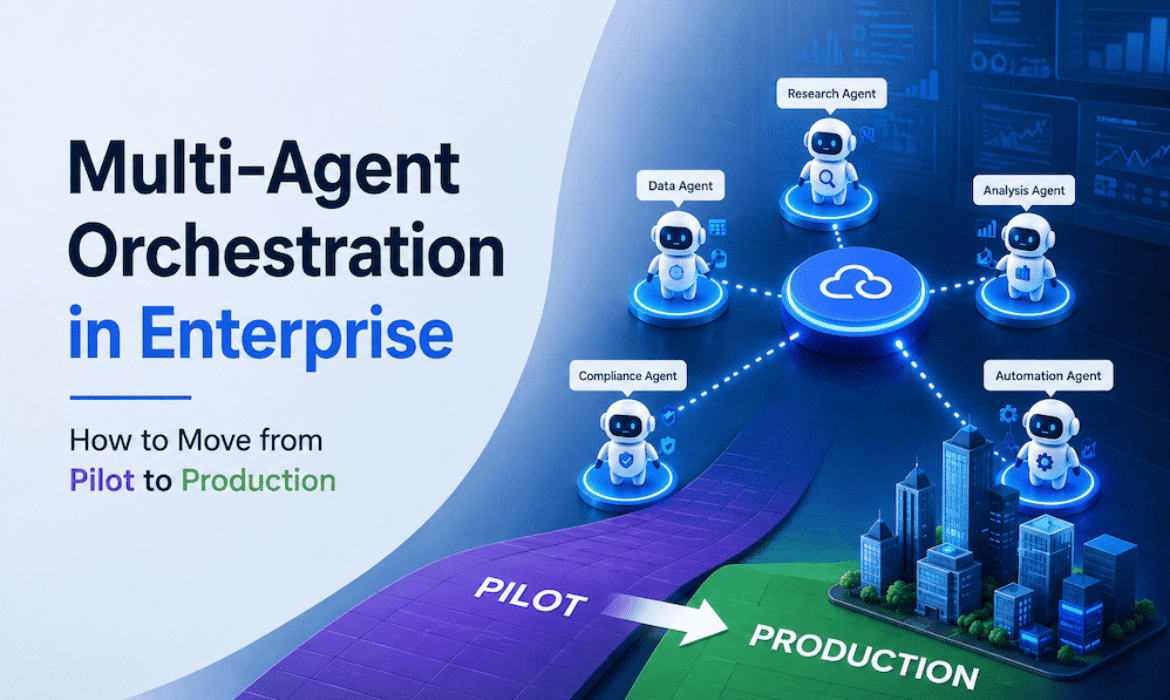
Consider an insurance carrier automating underwriting intake. The workflow touches document ingestion, risk scoring, compliance checks, policy lookup, and a human approval handoff. No single agent can own all of that reliably. This is why enterprises are moving to multi-agent systems: coordinated networks where specialized agents handle distinct parts of a workflow, pass context between each other, and surface outputs to humans at the right moments.
Three Orchestration Patterns That Work in Production
Supervisor/Worker is the most widely deployed pattern. A central supervisor routes subtasks to specialist agents and synthesizes their outputs. Think of it as a project manager delegating to experts. It works well for linear workflows like document review, intake triage, and customer service escalation. It struggles when the supervisor itself needs domain-specific reasoning.
Hierarchical Orchestration extends this across multiple levels. A top-level orchestrator manages mid-level supervisors, each running their own specialist pool. This is what enterprises use when a workflow spans departments with distinct rules. A supply chain system might have separate supervisors for procurement, logistics, and demand forecasting. The tradeoff is added latency and more points where context can be lost.
Peer-to-Peer Orchestration lets agents communicate directly without a central coordinator. It offers flexibility and low latency but is the hardest to govern. Most teams who try it early end up rebuilding with a supervisor model after their first production incident.
The Real Reason Multi-Agent Systems Fail
You can pick the right pattern and still fail. In our experience, the failure is almost never the pattern itself.
It is context inconsistency.
Agent A extracts a policy number and passes it to Agent B for a coverage lookup. Agent B expects a specific format. Agent A returns a slightly different format under edge conditions. Agent B fails silently, returns null, and the supervisor interprets null as “no coverage found” rather than “lookup failed.” The output is wrong, no error was logged, and no one noticed until a customer called.
Solving this requires three things before go-live: strict data contracts at every agent handoff (treat them like API contracts), explicit failure signaling so agents always return a reason alongside any null result, and end-to-end trace logging so you can reconstruct any execution step by step.
What Production Readiness Actually Requires
Getting to production is not primarily a technical problem. It is an operational one.
Before you go live, you need human-in-the-loop checkpoints at every high-stakes decision point. Start conservative and automate incrementally as you gain confidence in each stage. You need rollback capability at the agent level, not just the workflow level, so a failure in step 3 of 5 does not force you to restart from scratch. And every agent in production needs a named owner responsible for its performance, prompt maintenance, and incident response.
The organizations getting this right share one common habit: they treat multi-agent infrastructure as a platform investment, not a series of isolated projects. Each new workflow contributes reusable components and governance patterns that reduce the cost of the next deployment.
A Practical Starting Point
If you have a working pilot and are ready to move toward production, start here.
Map every data handoff between agents and document the expected input/output schema at each one. This single exercise surfaces most context inconsistency risks before you write any production code. Then instrument one workflow completely, including logging, monitoring, and rollback, validate it in production for 30 to 60 days, and use what you learn as your orchestration template.
Define human checkpoints before your engineers do. Business owners should decide what should not be automated yet. Engineers will automate as much as they can.
How CloudTern Can Help
At CloudTern, we help mid-market enterprises move from AI experimentation to AI operations. We have deployed multi-agent orchestration across insurance underwriting, supply chain, and healthcare workflows, with strict data contracts, end-to-end traceability, and governance frameworks your compliance team can work with.
If you are ready to move past the pilot stage, let’s talk.